India
 UAE

Treadmill Incline vs Speed: Which Setting Should You Use?
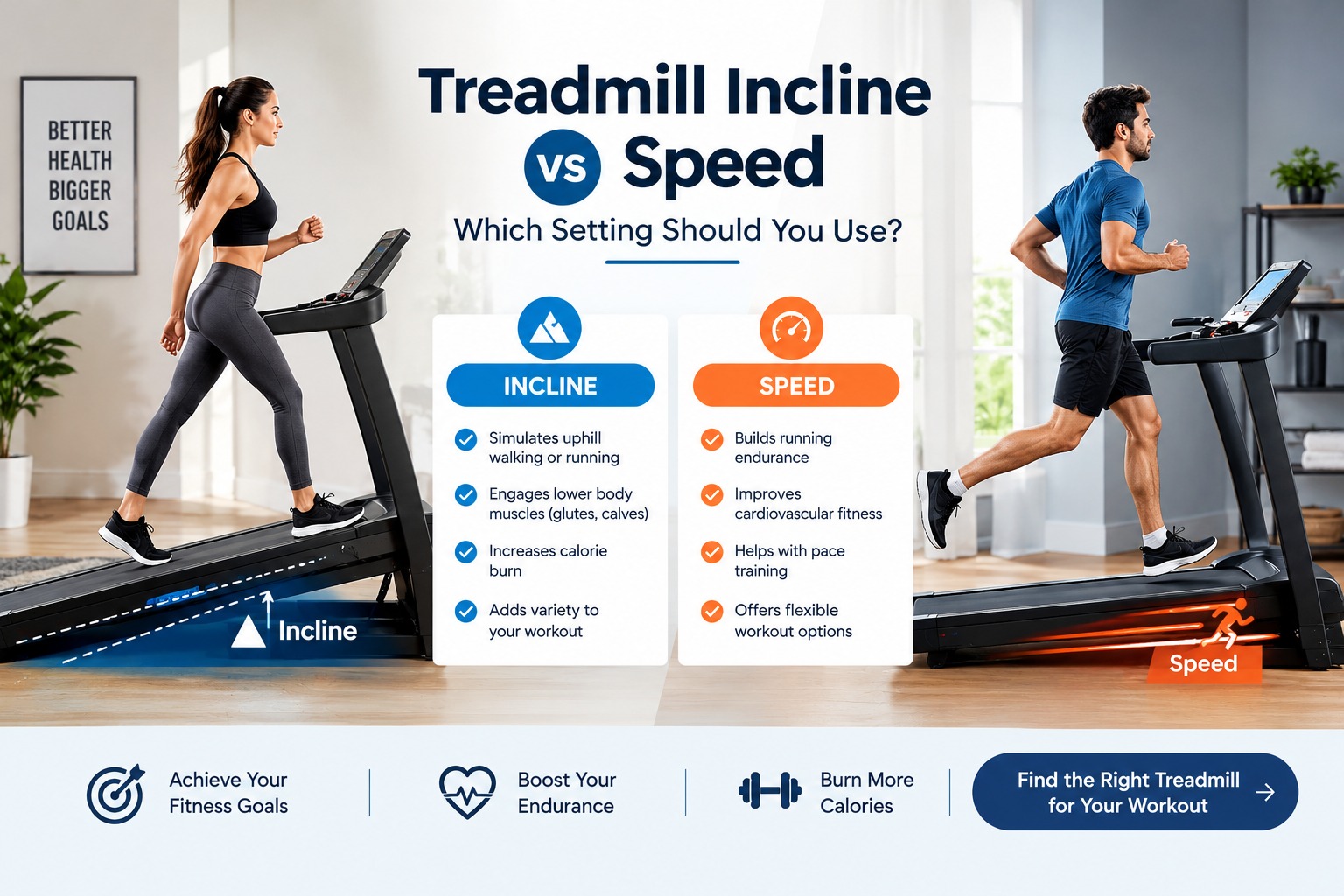
Choosing between treadmill incline and speed can make a difference to your workout intensity, endurance, and overall fitness routine.
Whether you walk regularly, enjoy jogging, or prefer running indoors, understanding how these two treadmill settings work can help you get more out of every session.
Many people wonder whether increasing treadmill speed or walking on an incline is better for burning calories, improving cardiovascular fitness, or building endurance. The answer depends on your fitness goals, current fitness level, and preferred workout style.
In this guide, we explain the difference between treadmill incline vs speed, the benefits of each setting, and how to choose the right combination for your workout.
What Is Treadmill Incline?
Treadmill incline refers to the upward slope of the running surface. When you increase the incline, the treadmill simulates walking or running uphill.
An incline workout generally requires more effort than walking at the same speed on a flat surface because your body must work against gravity.
If you want to add uphill walking to your home workout routine, choosing a treadmill with incline adjustment can give you more flexibility. Explore the TAC-400 AC Motorized Treadmill with Auto Incline from PowerMax Fitness UAE to learn more about the available features.
Benefits of Treadmill Incline
1. Increases Workout Intensity
Walking uphill can make your workout more challenging without requiring you to walk or run faster.
2. Engages Your Lower-Body Muscles
Incline walking places additional demands on muscles such as your glutes and calves. The amount of effort depends on the incline and your walking technique.
3. Supports Cardiovascular Fitness
Regular incline walking can help improve cardiovascular endurance when performed at an appropriate intensity.
4. Adds Variety to Your Workout
Changing the incline helps you create different workout intensities and makes your routine less repetitive.
5. Can Increase Energy Expenditure
Walking uphill typically requires more energy than walking at the same speed on a level surface. The actual difference depends on factors such as incline, speed, body weight, and workout duration.
What Is Treadmill Speed?
Treadmill speed determines how quickly the running belt moves. It is usually measured in kilometres per hour (km/h).
A lower speed is suitable for comfortable walking, while higher speeds allow for brisk walking, jogging, or running, depending on your fitness level.
Benefits of Increasing Treadmill Speed
1. Helps Develop Running Endurance
Gradually increasing your running speed can help you work towards improving your pace and endurance.
2. Supports Cardiovascular Conditioning
Walking briskly, jogging, and running can all improve cardiovascular fitness when performed consistently at a suitable intensity.
3. Offers Flexible Workout Options
You can adjust your speed to create recovery walks, steady-state cardio sessions, or intervals that alternate between faster and slower movement.
4. Helps You Progress Gradually
Starting at a comfortable pace and increasing speed over time allows you to adapt your workouts as your fitness improves.
5. Makes Pace-Based Training Easier
If you are training to walk or run a particular distance within a certain time, treadmill speed can help you practise maintaining your target pace.
Treadmill Incline vs Speed: Key Differences
Both treadmill incline and speed can make your workout more challenging, but they achieve this in different ways.
| Feature | Treadmill Incline | Treadmill Speed |
|---|---|---|
| What it changes | The slope of the running surface | The pace of your movement |
| Main purpose | Simulates uphill walking or running | Controls walking, jogging, or running pace |
| Workout intensity | Can increase effort without increasing pace | Increases effort by making you move faster |
| Muscle demands | Adds emphasis to uphill movement and lower-body muscles | Increases the demands of faster movement |
| Best suited for | Incline walking and uphill training | Pace training and running progression |
| Beginner approach | Start with a low or comfortable incline | Start with a comfortable walking pace |
| Progression | Increase the incline gradually | Increase speed gradually |
Neither setting is universally better. The right choice depends on what you want to achieve and which setting allows you to exercise comfortably and consistently.
Treadmill Incline vs Speed for Weight Management
If your goal is weight management, both treadmill incline and speed can contribute to your overall physical activity.
Walking at a higher incline may increase energy expenditure without requiring a faster pace. Increasing speed can also raise workout intensity, particularly when progressing from walking to jogging or running.
However, neither incline nor speed guarantees faster weight loss. Results depend on several factors, including your overall activity level, nutrition, workout consistency, and individual circumstances.
When Should You Choose Incline?
Incline walking may suit you if:
- You prefer walking rather than running.
- You want to increase workout intensity gradually.
- You enjoy uphill-style cardio workouts.
- You want to vary your routine without continually increasing your pace.
Start with a comfortable walking speed and a low incline. Increase the slope gradually only when you can maintain good posture and a controlled walking rhythm.
When Should You Choose Speed?
Speed progression may suit you if:
- You want to improve your walking pace.
- You are preparing to jog or run continuously.
- You want to practise running at a consistent speed.
- You prefer alternating between faster and slower intervals.
Increase your pace gradually rather than jumping immediately to a high speed.
Which Treadmill Setting Is Best for Beginners?
For beginners, the best treadmill setting is one that feels manageable and allows you to exercise safely.
Start with a flat or low-incline treadmill setting and a comfortable walking speed. Focus on maintaining a steady rhythm without feeling excessively breathless.
If you prefer walking workouts at home, the PowerMax WALKPAD-2 Walking Treadmill offers a compact design, walking-focused speed settings, and manual incline options. Check the product specifications to see whether it suits your workout requirements.
As your fitness improves, you can gradually introduce either a small incline or a slightly faster pace.
| Workout Goal | Beginner Approach |
|---|---|
| Comfortable walking | Begin with a flat surface and an easy pace |
| Brisk walking | Increase your speed slightly while maintaining control |
| Uphill walking | Introduce a low incline and keep your pace comfortable |
| Jogging | Increase your speed gradually when you are ready to progress beyond walking |
You do not need to use a steep incline or a high speed to make your workout worthwhile. Consistency is more important than choosing the most challenging setting.
Should You Combine Treadmill Incline and Speed?
Yes. Combining incline and speed can provide variety and help you adjust workout intensity to suit your goals.
A treadmill that supports adjustable incline and speed can help you vary your workout intensity. For example, the PowerMax TDA-125 Motorized Treadmill with Auto Incline offers 15 levels of automatic incline and a speed range of 1–18 km/h.
However, increasing both settings at the same time can make a workout challenging very quickly. If you are new to treadmill training, change one setting at a time so you can understand how your body responds.
Example Treadmill Workout for Beginners
| Workout Stage | Duration | Suggested Setting |
|---|---|---|
| Warm-up | 5 minutes | Easy walking on a flat surface |
| Main workout | 10 minutes | Comfortable, steady walking |
| Optional incline | 3–5 minutes | Slight incline at a manageable pace |
| Cool-down | 5 minutes | Slow walking on a flat surface |
Adjust the duration and incline according to your fitness level. If the incline feels too challenging, return to a flat surface.
Example Treadmill Workout for Intermediate Users
| Workout Stage | Duration | Suggested Setting |
|---|---|---|
| Warm-up | 5 minutes | Easy walking |
| Steady walking | 5 minutes | Brisk but comfortable pace |
| Incline interval | 3 minutes | Moderate incline at a controlled pace |
| Recovery | 3 minutes | Lower incline and comfortable pace |
| Repeat | 10–15 minutes | Alternate manageable incline and recovery periods |
| Cool-down | 5 minutes | Gradually slow down |
These are example structures rather than fixed prescriptions. Choose settings that match your fitness level, and reduce the intensity if you cannot maintain a comfortable, controlled workout.
How to Choose a Treadmill With the Right Incline and Speed Features
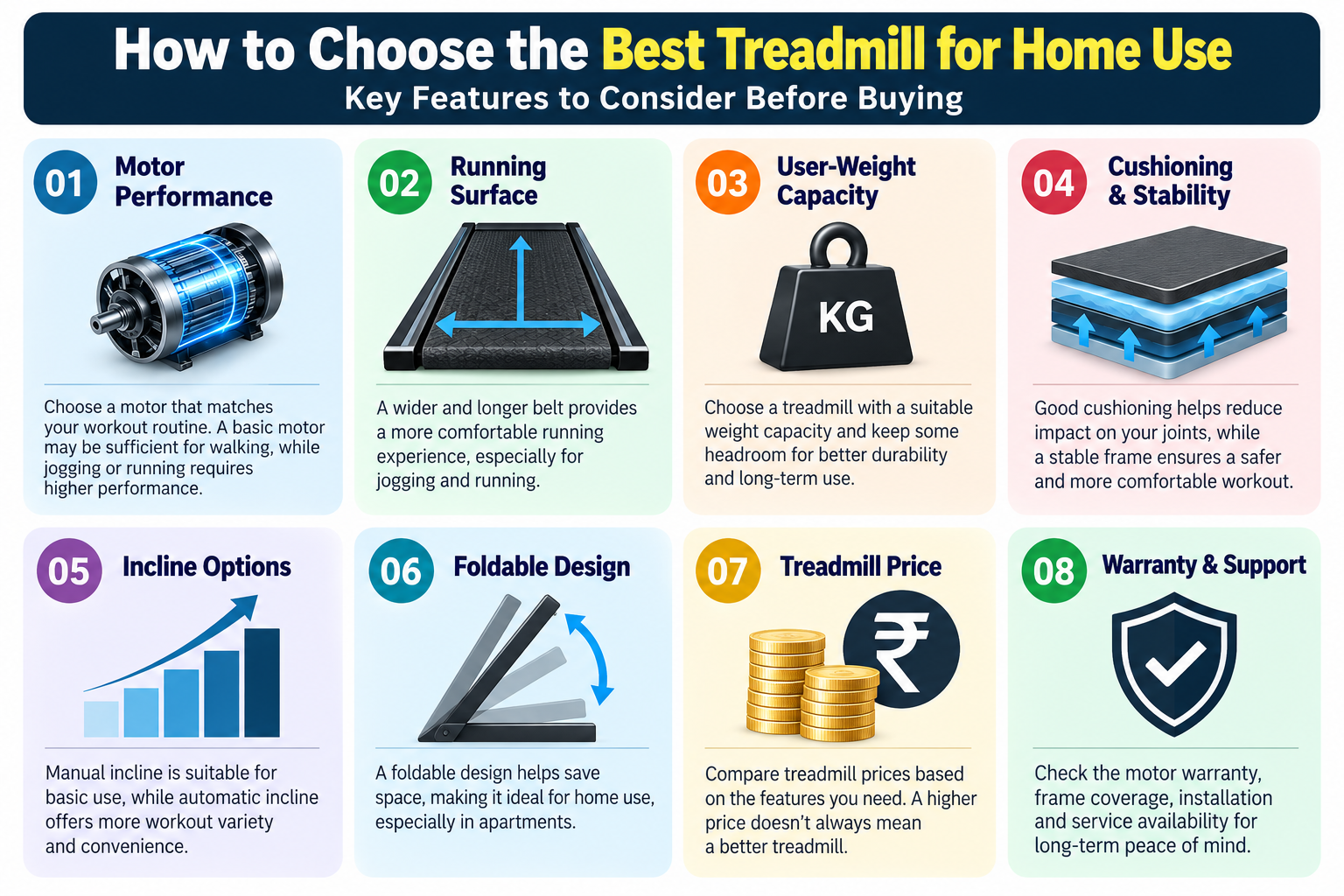
If you are planning to buy a treadmill for home use, consider the features that support your preferred workout.
1. Incline Adjustment
Some treadmills offer a fixed running surface, while others have manual or automatic incline adjustment. Check which type is available and whether it provides the range you need.
2. Speed Range
Look for a treadmill with a speed range that accommodates your intended activities, whether that means comfortable walking, brisk walking, jogging, or running.
3. Running Surface
Choose a running surface that provides adequate room for your stride and feels comfortable for your intended workout.
4. User Weight Capacity
Check the manufacturer's maximum user weight specification before purchasing a treadmill. Choose equipment suitable for the intended user.
5. Safety and Convenience Features
Consider features such as an emergency safety key, accessible controls, cushioning, and a display that makes it easy to monitor your workout.
6. Space and Storage
If you live in an apartment or have limited workout space, consider the treadmill's dimensions, folding design, and available storage area.
Explore the PowerMax Fitness UAE treadmill range to compare available models and find equipment that suits your home workout requirements.
Common Mistakes to Avoid When Using Treadmill Incline and Speed
To make your treadmill sessions more comfortable and productive, avoid these common mistakes:
Starting at an Excessive Incline
A steep incline can make walking difficult, especially for beginners. Start with a manageable setting and progress gradually.
Increasing Speed Too Quickly
Sudden changes in pace can affect your balance and running technique. Increase speed in small steps.
Holding the Handrails Throughout the Workout
Relying heavily on the handrails can change your natural walking posture. Use them for balance when needed and choose settings that allow you to move comfortably without leaning on them.
Skipping the Warm-Up
Begin with easy movement before progressing to a more demanding workout.
Ignoring Discomfort
Stop if you experience chest pain, dizziness, unusual shortness of breath, or significant pain. Seek appropriate medical advice when necessary.
Choosing Settings Based Only on Calorie Estimates
Treadmill calorie displays provide estimates rather than exact measurements. Focus on consistent exercise, appropriate intensity, and your overall fitness goals.
Final Thoughts: Treadmill Incline vs Speed
When comparing treadmill incline vs speed, remember that each setting offers different benefits.
Incline walking is useful for adding an uphill challenge without necessarily increasing your pace. Increasing speed is useful for progressing from comfortable walking to brisk walking, jogging, or running.
You can also combine both settings to add variety to your routine, provided the workout matches your fitness level.
The best treadmill workout is one that supports your goals, feels manageable, and helps you stay consistent over time.
Looking for a treadmill for your home workouts? Explore PowerMax Fitness UAE's treadmill collection to compare available features, speed ranges, incline options, and designs before choosing the right equipment for your needs.
Frequently Asked Questions
Is treadmill incline better than speed?
Neither is always better. Incline increases the demands of uphill movement, while speed increases the pace of your workout. Choose according to your goals, fitness level, and comfort.
Is walking on an incline better than running?
Incline walking and running are different forms of exercise. Incline walking can provide a challenging workout at a lower speed, while running involves faster movement and different physical demands. Your preferred option depends on your fitness, experience, and goals.
Does increasing treadmill incline burn more calories?
Increasing the incline generally increases the energy required to walk at the same speed. However, the number of calories burned depends on factors such as body weight, workout duration, speed, and incline.
What treadmill incline should a beginner use?
Beginners can start on a flat surface or with a very slight incline. Increase the incline gradually as your comfort and fitness improve. There is no single incline setting that is right for everyone.
Can I walk on a treadmill every day?
Many people can include walking in their daily routines, provided the duration and intensity suit their fitness and health. Start gradually, allow recovery when needed, and seek professional guidance if you have relevant medical concerns.
Does every treadmill have an automatic incline feature?
No. Some treadmills have manual incline adjustment, some have automatic incline adjustment, and others have no incline feature. Check the specifications of the model before purchasing.