India
 UAE

Are Fitness Trackers Accurate? Do They Actually Make You Fitter?
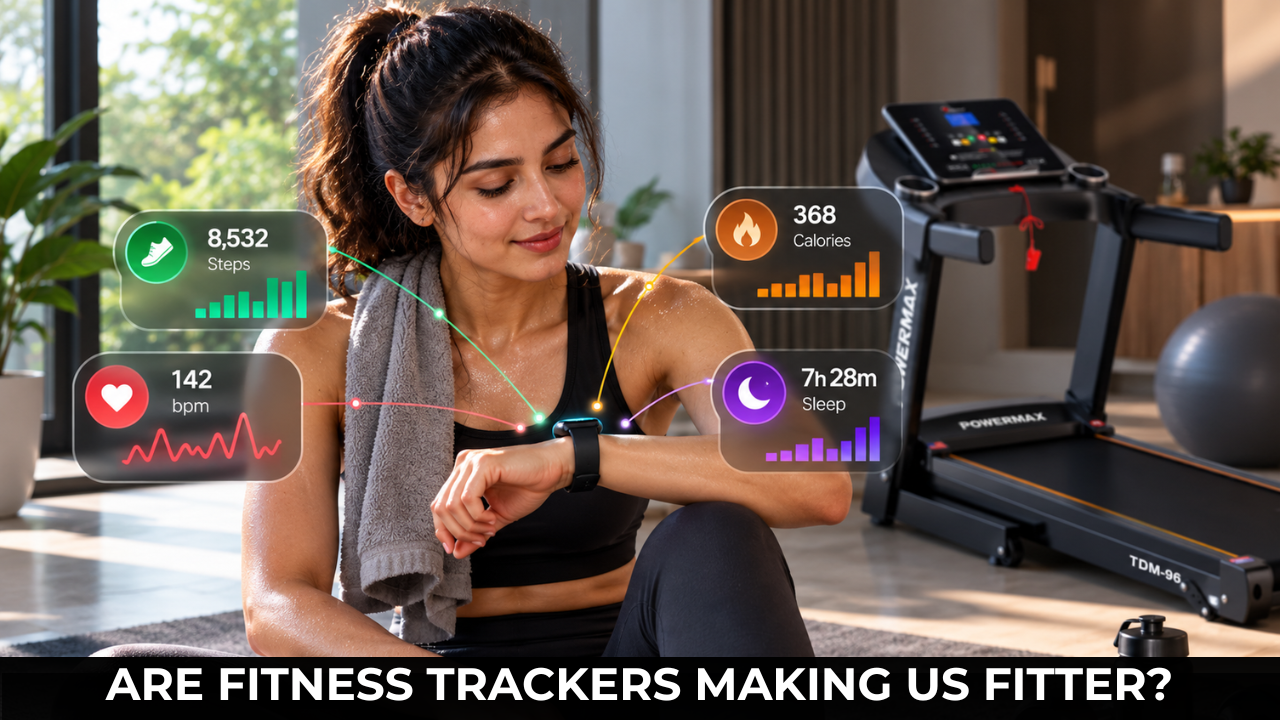
There is something slightly strange about finishing a workout and immediately checking your wrist to see whether it “counted.” Maybe it says 6,214 steps. Maybe 342 calories. Maybe your heart rate peaked at 151. There might even be a little ring waiting to be closed.
The numbers are useful. They can also become strangely persuasive. A fitness tracker can make an afternoon walk feel more purposeful, remind you to get off the chair, and show you that you've been more active this week than last week.
Research suggests wearable trackers can increase daily steps and moderate-to-vigorous physical activity. But the same research into wearable accuracy tells a more complicated story, particularly when it comes to calories burned. So, how much should you actually trust the numbers on your wrist?
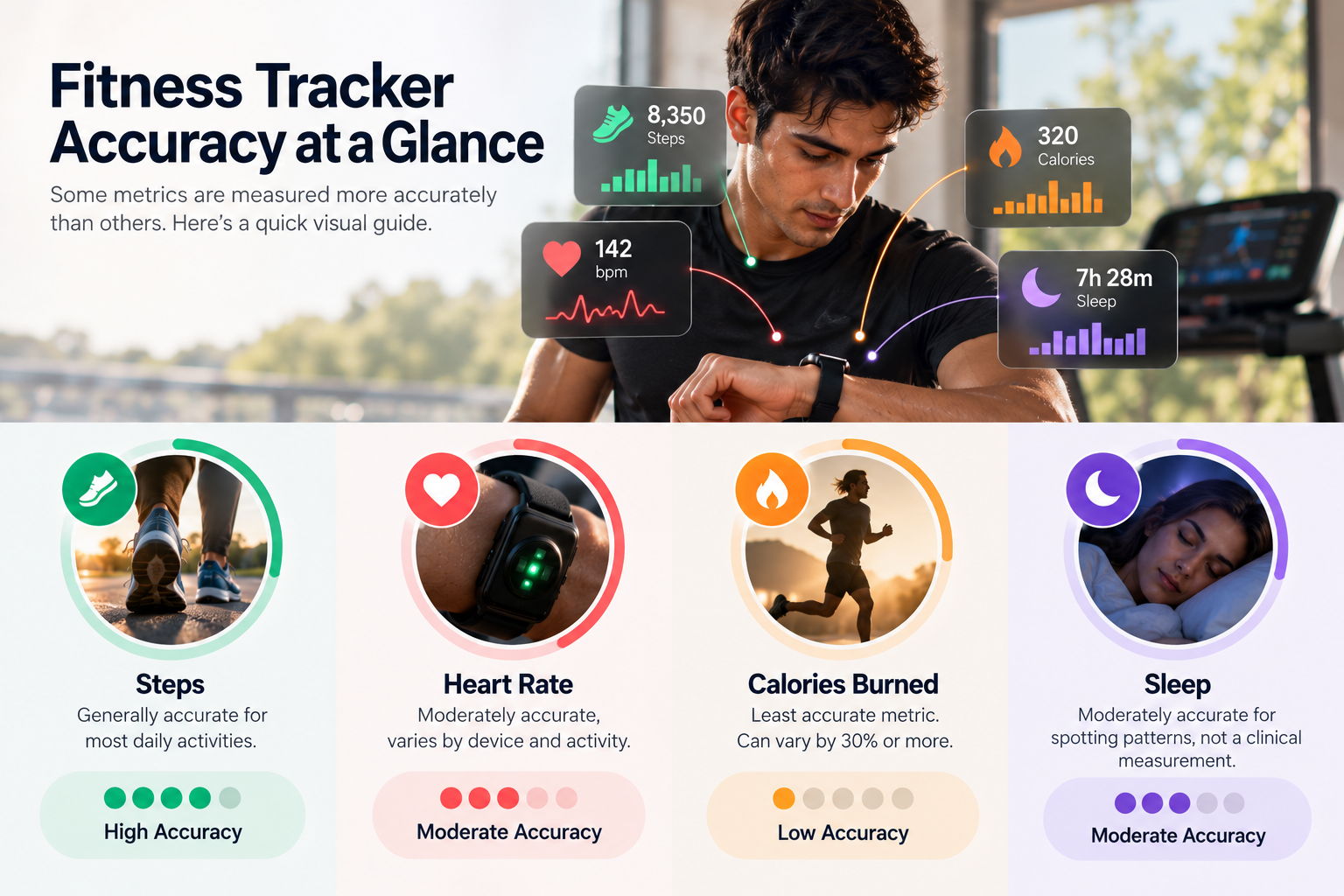
Fitness Trackers Don't Measure Everything Equally Well
The easiest way to answer whether fitness trackers are accurate is to stop treating “accuracy” as one thing.
A step count isn't the same measurement as calorie expenditure. Heart rate isn't measured in the same way as sleep. Some metrics are relatively straightforward for a wearable to estimate; others involve considerably more guesswork.
A systematic review examined 158 publications covering nine commercial wearable brands. The researchers found that several devices measured steps reasonably accurately in laboratory settings, while heart-rate accuracy varied by device.
Calories Are the Weak Point
Energy expenditure was the weak point: none of the brands reviewed was accurate for estimating energy expenditure. That distinction is worth remembering the next time your watch tells you that your workout burned exactly 417 calories. It didn't actually measure 417 calories leaving your body. It estimated them.
Step Counts Are Probably More Useful Than Your Calorie Number
Step tracking is one of the more practical things a wearable can do.
The same systematic review found that Fitbit, Apple Watch and Samsung devices appeared to measure steps accurately in laboratory-based testing, although performance varied with the device and conditions.
Another systematic review looking specifically at Fitbit devices found that step-count accuracy was generally better than its energy-expenditure accuracy, although results varied across studies and activities.
A Better Way to Use Step Counts
Use them for comparing your own activity over time.
If your normal weekday is around 4,000 steps and you've gradually moved that average towards 6,000, the number has given you useful feedback. You don't necessarily need to know whether those 6,000 steps were perfectly counted. The trend is what matters.
Calories Are Where Things Get Complicated
Calories burned are probably the number people should treat with the most caution.
Unlike counting steps, a wrist-worn device cannot directly measure how much energy your body has used during a workout. It estimates energy expenditure using information such as movement, heart rate and personal characteristics.
A systematic review and meta-analysis examining wrist- and arm-worn activity monitors found that energy-expenditure estimates could differ substantially from criterion measurements such as indirect calorimetry.
Another review of 65 studies found that the mean absolute percentage error for energy expenditure was greater than 30% across all brands assessed.
If your fitness tracker says you burned 500 calories, think of that as an estimate that may help you understand your workout, not a precise number to build your entire diet around.
What About Heart Rate?
Heart rate sits somewhere in the middle.
The large 158-publication review found that heart-rate accuracy varied between devices. Apple Watch and Garmin performed particularly well in the studies included, while Fitbit tended to underestimate heart rate.
That doesn't mean one brand will always be right and another will always be wrong. Devices change, algorithms are updated, and accuracy can vary depending on activity and how the wearable is being used.
For everyday exercise, heart-rate data can still be useful for understanding intensity and trends. If you notice that the same treadmill walk now produces a lower heart rate than it did a few months ago, for example, that can be interesting feedback. It just shouldn't be treated as laboratory-grade measurement.
So, Do Fitness Trackers Actually Make Us Fitter?
This is where the answer gets more encouraging.
A systematic meta-analysis covering 48 papers from 44 distinct trials found that interventions using wearable activity trackers significantly increased daily steps and weekly moderate-to-vigorous physical activity.
The researchers did not find the same effect on light physical activity or sedentary behaviour.
More recent research points in the same direction, although with some important caveats. A 2025 systematic review and meta-analysis examined 18 randomised controlled trials involving 1,674 adults and found that standalone digital behaviour-change interventions significantly improved physical activity.
However, the researchers rated the certainty of the evidence for physical activity as low, partly because of risk of bias and publication bias.
The useful takeaway: Fitness trackers can encourage people to become more active, but wearing one doesn't automatically make someone fitter. The way the technology is used matters.
When the Number Starts Running the Workout
Here's where things get interesting.
A tracker can be a gentle nudge. You see you've been sitting for most of the afternoon, so you go for a walk. You notice your weekly activity has fallen, so you make time for another workout. You realise your average steps have increased over the past month, and that's motivating.
Great. But the relationship can change.
You walk around the living room because you're 400 steps short of your goal. You feel guilty because you didn't close your activity rings. You abandon a perfectly good workout because your watch says your recovery isn't optimal.
Suddenly, the workout isn't the point anymore. The number is.
The 10,000-Step Trap
Few numbers have become as familiar in fitness as 10,000. But your body doesn't suddenly recognise a magical threshold when your watch changes from 9,999 to 10,000.
A step goal can be a useful target because it gives people something concrete to work towards. It isn't a biological pass mark.
That difference matters. If you've walked 8,500 steps and feel good, another 1,500 steps may or may not be useful depending on the rest of your day.
If you've spent an hour doing a challenging workout, your fitness tracker doesn't need to declare the session a success for it to have been worthwhile. The goal should be more useful movement, not perfect numbers.
What Should You Actually Pay Attention To?
You don't have to ignore your tracker. You just don't need to believe everything it tells you equally.
| Metric | How to Use It |
|---|---|
| Steps | Look at trends and daily movement |
| Workout duration | A simple measure of consistency |
| Heart rate | Useful for understanding exercise intensity |
| Distance | Helpful for tracking progress in repeatable activities |
| Calories burned | Treat as an estimate, not an exact measurement |
| Sleep score | Look for patterns rather than judging one night |
| Recovery/readiness scores | Use as additional context, not a final verdict |
The most valuable number might not even be on your wrist. It could be how often you actually exercise each week.
Your Treadmill Doesn't Need to Agree With Your Watch
Consider a simple home workout. You spend 30 minutes walking on a treadmill. The machine records your speed, distance and workout time. Your fitness tracker records steps and perhaps heart rate. Your phone might add another layer of information.
None of those numbers is the workout itself. They're different ways of describing it.
That distinction becomes particularly useful with Home Fitness Equipment. If you're using a treadmill regularly, the biggest win isn't necessarily getting the perfect calorie estimate. It's creating a routine you can actually maintain.
A 30-minute treadmill session you repeat three or four times a week is far more meaningful than spending the same amount of time trying to make your fitness dashboard look perfect.
A Better Way to Use Your Fitness Tracker
Think of the tracker as a feedback loop:
Track → Notice → Adjust → Move On
1. Track
Track what you're doing.
2. Notice
Notice patterns rather than judging individual days.
3. Adjust
Adjust your routine when the information is genuinely useful.
4. Move On
Move on with your day instead of constantly checking the numbers.
You don't need to check your wrist every few minutes. You don't need to hit an arbitrary number at all costs. And you certainly don't need to let an estimated calorie figure decide whether your workout was worthwhile.
The technology is there to support the habit. It shouldn't become the habit.
So, Are Fitness Trackers Worth Using?
For many people, yes, particularly if seeing your activity makes you more likely to walk, exercise or stick to a routine.
Steps can be useful. Heart rate can provide helpful context. Calorie expenditure is much harder to estimate accurately.
And no fitness tracker can tell you whether you enjoyed your workout, whether you feel stronger than you did six months ago, or whether exercise has become a part of your life rather than another task to complete.
Your fitness tracker is a dashboard. It isn't the driver.
Frequently Asked Questions
Are fitness trackers accurate?
Are fitness trackers accurate for calories burned?
Do fitness trackers actually make you fitter?
Are fitness trackers accurate for steps?
Should you trust your fitness tracker calories?
Should you exercise based on your fitness tracker?
Final Takeaway
Fitness trackers can be useful for spotting patterns, building awareness and encouraging more activity. But not every metric deserves the same level of trust. Use the data as feedback, focus on trends rather than perfect numbers, and remember that the technology should support your fitness habits rather than control them.